← The Temasek Timeline
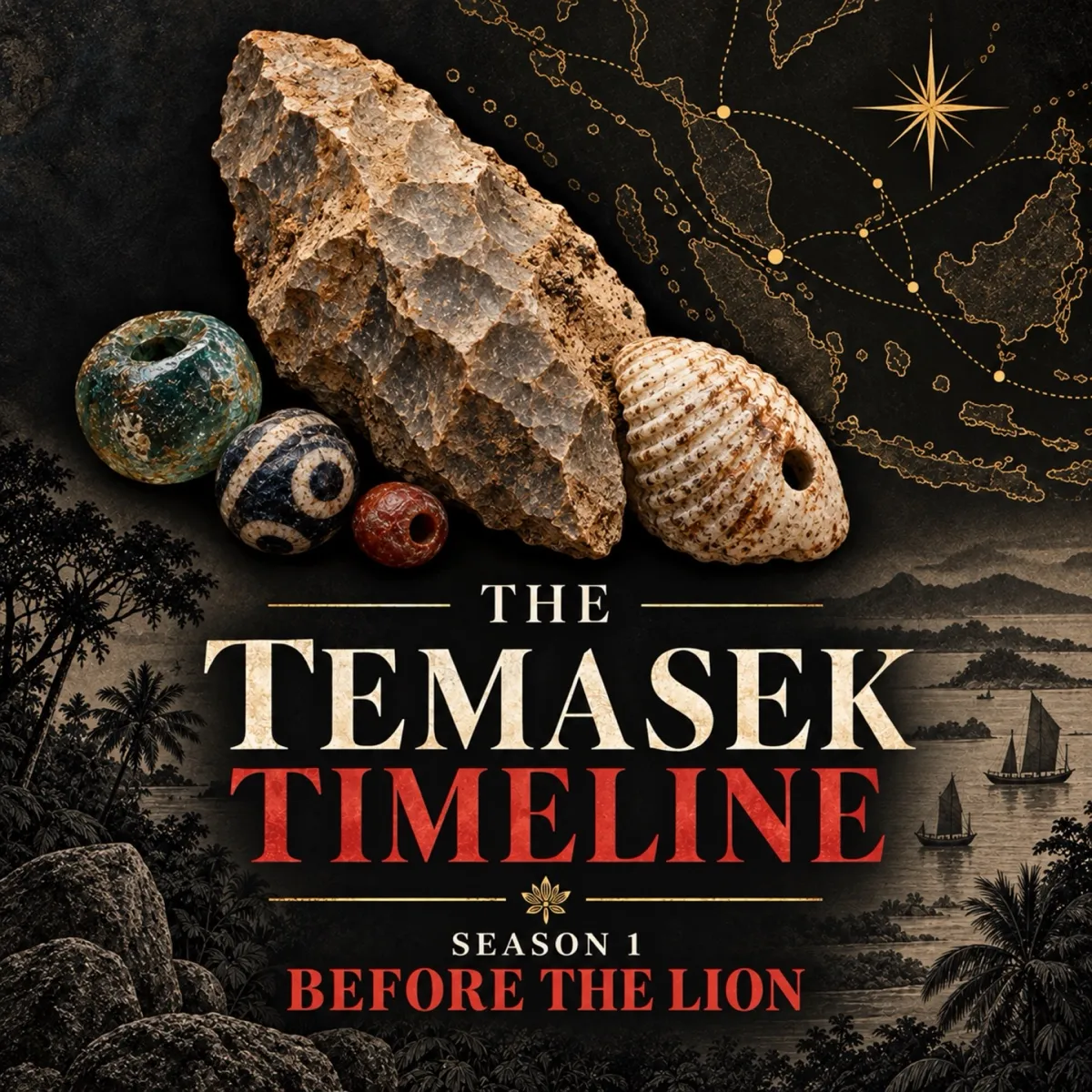
Season 1: Before the Lion cover art
Season 1 · Deep prehistory to c. 1300Now airing

Before the Lion

Rock, sea, first peoples and trade winds, before Temasek has a name.

16 episodes, new ones every Tuesday and Thursday. Start at the top and listen in order.

Episode 001 · Season 1Thursday, 1 October 2026

How Singapore Island Was Formed

Before Temasek. Before Singapura. Before anyone named this place at all, something had already decided its shape.

Strip away the towers, the cranes and the reclaimed shoreline, and what's left is rock: older and stranger than the city on top of it. Why has this island never trembled like its neighbours? And what did a hill, a river mouth and a slow-moving sea have to do with everything that came later?

Sources
  • Avijit Gupta (ed.), The Physical Geography of Southeast Asia (2005)
  • Bird, Taylor & Hunt, "Palaeoenvironments of Insular Southeast Asia during the Last Glacial Period," Quaternary Science Reviews 24 (2005)
Episode 002 · Season 1Thursday, 1 October 2026

Singapore in the Ice Age: Walking to Sumatra

Twenty thousand years ago, you could set out from where Singapore now stands and walk to Sumatra without wetting your feet.

Beneath today's busy straits lies a vanished continent. What did it look like? Who crossed it? And how quickly did the sea take it back?

Sources
  • Bird, Taylor & Hunt, "Palaeoenvironments of Insular Southeast Asia during the Last Glacial Period," Quaternary Science Reviews 24 (2005)
  • Peter Bellwood, Prehistory of the Indo-Malaysian Archipelago (1997)
Episode 003 · Season 1Tuesday, 6 October 2026

The First People of Sundaland

Every history needs a starting cast. This one left behind stone tools, shell heaps and very little else.

Meet the Hoabinhian: a toolmaking tradition named after an ordinary Vietnamese village, yet spread across tens of thousands of years. Who were they? Why is there no confirmed trace of them on Singapore itself? And who might still carry their ancestry today?

Sources
  • Charles Higham, The Archaeology of Mainland Southeast Asia (1989)
  • Peter Bellwood, Prehistory of the Indo-Malaysian Archipelago (1997)
  • Ian Glover & Peter Bellwood (eds.), Southeast Asia: From Prehistory to History (2004)
Episode 004 · Season 1Thursday, 8 October 2026

The Austronesian Expansion Reaches the Straits

Every time someone orders at a hawker stall in Malay, they carry forward one of the great migrations in human history.

It begins on an island far to the north, with canoes, rice and a language that would travel from Madagascar to Easter Island. How do linguists trace it? And was it really a conquest, or something far more tangled?

Sources
  • Peter Bellwood, Prehistory of the Indo-Malaysian Archipelago (1997)
  • Ian Glover & Peter Bellwood (eds.), Southeast Asia: From Prehistory to History (2004)
Episode 005 · Season 1Tuesday, 13 October 2026

Who Are the Orang Laut?

Some characters return in every chapter of this story. Few return as often as the sea people.

Royal navy to feared raider: the same fleet, the same waters, depending on who was telling the tale. Who were the Orang Laut? Why did kings need them so badly? And why did their loyalty follow a person rather than a place?

Sources
  • David E. Sopher, The Sea Nomads (1965)
  • Barbara Watson Andaya & Leonard Y. Andaya, A History of Malaysia, 2nd ed. (2001)
  • Cynthia Chou, Indonesian Sea Nomads (2003)
Episode 006 · Season 1Thursday, 15 October 2026

Orang Laut: Life on the Water

Picture a home that moves with the tide, and carries the family, the cooking fire and everything owned wherever the day's work leads.

For many families across many centuries, this was simply life. What was it like? And why did every power that wanted these waters need the people who lived on them?

Sources
  • David E. Sopher, The Sea Nomads (1965)
  • Barbara Watson Andaya & Leonard Y. Andaya, A History of Malaysia, 2nd ed. (2001)
  • Cynthia Chou, Indonesian Sea Nomads (2003)
Episode 007 · Season 1Tuesday, 20 October 2026

The Maritime Silk Road Begins

Say "Silk Road" and most people picture camels and deserts. The older, busier route went by sea.

For over a thousand years, it ran right past the future site of Singapore. What travelled along it? And who was watching the ships go by?

Sources
  • Kenneth R. Hall, A History of Early Southeast Asia: Maritime Trade and Societal Development, 100–1500 (2011)
  • Regina Krahl et al. (eds.), Shipwrecked: Tang Treasures and Monsoon Winds (2010)
  • Tansen Sen, Buddhism, Diplomacy, and Trade (2003)
Episode 008 · Season 1Thursday, 22 October 2026

Indian Influence Arrives

Some of history's biggest changes arrive quietly, carried by merchants and scholars rather than soldiers.

How did Indian religion, art and ideas reshape the rulers of Southeast Asia for over a thousand years, without a single invasion? And what did that layer leave behind long before Islam arrived?

Sources
  • George Coedès, The Indianized States of Southeast Asia (1968)
  • Kenneth R. Hall, A History of Early Southeast Asia: Maritime Trade and Societal Development, 100–1500 (2011)
Episode 009 · Season 1Tuesday, 27 October 2026

Funan: The Region's First Recorded Power

One port in the Mekong Delta has given up Roman coins, Indian gemstones and Chinese bronze mirrors in the very same layer of earth.

Who ran a place where three great trading worlds met? How do we know about it when so little of its own writing survives? And what did this first kingdom teach later powers about building wealth without vast farmland?

Sources
  • George Coedès, The Indianized States of Southeast Asia (1968)
  • Ian Glover and Peter Bellwood, Southeast Asia: From Prehistory to History (2004)
  • Kenneth R. Hall, A History of Early Southeast Asia (2011)
Episode 010 · Season 1Thursday, 29 October 2026

The Golden Chersonese

Around the year 150, a Greek geographer in Alexandria wrote about a golden peninsula at the far edge of the known world.

He never went there. So where did his information come from? Which port near the peninsula's southern tip has scholars arguing to this day? And what does a single ancient map tell us about how early this region caught the world's attention?

Sources
  • Paul Wheatley, The Golden Khersonese (1961)
  • Kenneth R. Hall, A History of Early Southeast Asia (2011)
Episode 011 · Season 1Tuesday, 3 November 2026

Where Was Ptolemy's Sabana?

A single Greek word has kept scholars arguing for over a century. Sabana, a port near the tip of Ptolemy's golden peninsula.

Four candidate sites have serious supporters, and one of them is Singapore. What does each camp point to in Ptolemy's coordinates? Why did the leading scholar refuse to pick a winner? And what would it take to settle the question?

Sources
  • Paul Wheatley, The Golden Khersonese (1961)
Episode 012 · Season 1Thursday, 5 November 2026

Early Chinese Records of the Southern Seas

Picture a filing cabinet stretching back two thousand years, dated with care and preserved through dynasty after dynasty.

Imperial China kept watch on the Southern Seas, and its officials wrote down who arrived and what they carried. Why did tribute missions matter so much to the rulers who sent them? What happens to a place name once it passes through a Chinese scribe? And what can these records never tell us?

Sources
  • Wang Gungwu, The Nanhai Trade (2003)
  • Friedrich Hirth and W. W. Rockhill, Chau Ju-Kua (1911)
  • Derek Heng, Sino-Malay Trade and Diplomacy from the Tenth through the Fourteenth Century (2009)
Episode 013 · Season 1Tuesday, 10 November 2026

Faxian and Yijing: Chinese Monks at Sea

Most of our evidence comes from officials and secondhand reports. These two men actually made the voyage and wrote down what they saw.

Faxian sailed home from India around 412. Yijing stayed at Srivijaya for a time to study. What did they find in the ports along the way? What did life aboard a monsoon ship look like? And why did their accounts survive when so much else vanished?

Sources
  • James Legge, A Record of Buddhistic Kingdoms (1886)
  • J. Takakusu, A Record of the Buddhist Religion as Practised in India and the Malay Archipelago (1896)
  • Tansen Sen, Buddhism, Diplomacy, and Trade (2003)
Episode 014 · Season 1Thursday, 12 November 2026

The Rise Of Srivijaya

A river port in southern Sumatra grew into the dominant power of the Straits and held that place for centuries.

It had little farmland and no vast population. So what was its source of strength? Why did its rulers send envoys to China so faithfully? And what did visiting monks find when they came to study there?

Sources
  • O. W. Wolters, Early Indonesian Commerce (1967)
  • O. W. Wolters, The Fall of Srivijaya in Malay History (1970)
  • George Coedès, The Indianized States of Southeast Asia (1968)
  • Kenneth R. Hall, A History of Early Southeast Asia (2011)
Episode 015 · Season 1Tuesday, 17 November 2026

Srivijaya's Grip on the Straits of Malacca

A kingdom with modest farmland and a small population controlled one of the richest trade corridors of the ancient world.

What choice did a merchant face when sailing between the Indian Ocean and the South China Sea? What kept ships paying the toll? How did a small kingdom back its claim with force and diplomacy? And how far did that control really reach?

Sources
  • O. W. Wolters, Early Indonesian Commerce (1967)
  • Kenneth R. Hall, A History of Early Southeast Asia (2011)
  • Paul Wheatley, The Golden Khersonese (1961)
Episode 016 · Season 1Thursday, 19 November 2026

Was There a Settlement on Singapore Before Temasek?

Ships passed this island for centuries. Did anyone live here?

The location would suggest a stopover, yet the evidence stays thin. What have archaeologists found so far, and why does it fall short of a settlement? Why are the written sources so hard to pin down? And what kind of discovery could finally settle a question that is still open?

Sources
  • John N. Miksic, Singapore and the Silk Road of the Sea, 1300-1800 (2013)

Back to all eight seasons

Walk the Story

Hear it here. Then stand on the spot.

Serai Tour Services leads storywalks through the city's streets, gardens and quieter corners. The places in this series are places we take people.